How Is a Road Weather Station Built? Signaal TM’s Project Manager Explains
It is a winter night. Most people are asleep, but a light is still on in one office. A road maintenance manager is carefully monitoring road weather forecasts and measurement data arriving from road weather stations. Precipitation is approaching, temperatures are fluctuating around zero, and every degree can make the difference between wet asphalt and an icy road. It is time to decide whether to send road maintenance vehicles out or keep them at the depot. This is not a decision based on gut feeling.
Behind it are road weather forecasts, models and data collected by road weather stations, which help determine when and where road conditions are likely to become dangerous.
AS Signaal TM has been building and maintaining road weather stations for the Estonian Transport Administration since 2013. Over the years, we have contributed to the construction of numerous new stations and the modernisation of existing systems. In this article, our project manager Aldo Tatter explains how a road weather station is built, from selecting its location to transmitting the first measurement results to a server. We also explore why road weather stations are so important for road safety and maintenance.

Purpose
Why do we need road weather stations?
In a nutshell, the purpose of road weather stations is to make road travel safer.
More specifically, road weather stations form an essential part of an integrated modern road safety and maintenance system. Their role is indispensable because the measurement data they collect enables reliable road weather forecasts to be produced. These forecasts inform decisions made by both road maintenance contractors and traffic management authorities. All countries that experience winter road conditions invest in road weather monitoring because slippery surfaces, snow, freezing rain and poor visibility can pose significant risks to road users.
This is why road weather stations are particularly important in Nordic countries and other regions where road surface temperatures regularly fall below zero.
Road maintenance contractors are the primary daily users of data collected by road weather stations. Their key questions are when and where to deploy maintenance crews and how much chloride-based or other anti-icing materials to use. If a forecast indicates that the road surface is likely to freeze within the next few hours or snowfall is approaching, maintenance teams can respond proactively. This helps prevent dangerous road conditions before they develop. Road weather stations are equally important for the work of the Estonian Transport Administration.
Measurement data provides an overview of actual road conditions, helps inform road users about potential hazards and enables the authorities to assess whether road maintenance meets the required standards.
Although installing and operating a modern road weather station requires a significant investment, these systems are considered one of the most cost-effective road safety measures. According to various international estimates, every euro invested in establishing or maintaining a road weather monitoring network can generate five to ten euros in societal benefits. The greatest value comes from preventing traffic accidents, reducing the number of injuries and saving lives.
Accurate road weather forecasts also make maintenance operations more efficient by reducing unnecessary deployments and optimising the use of chlorides, fuel and labour.
A road weather station is therefore much more than a measuring device beside the road. It is a tool that supports daily decisions affecting road safety, maintenance quality and overall societal costs.
How does a road weather station project begin?
Projects typically originate from the needs of the road owner and road maintenance contractor, which may lead the road owner to initiate a public procurement procedure.
The main reasons for launching road weather station projects are:
- Expanding the road weather station network. The denser the network, the more accurate the measurement data that can be collected. This enables road weather models to produce more reliable forecasts and supports better decisions on road maintenance and safety.
- Additional requirements for the data collected. The Estonian Transport Administration continuously develops its road safety and traffic management systems. For example, the construction of dual carriageways with two lanes in each direction and traffic-managed road sections may require additional sensors or the replacement of existing equipment with more advanced solutions.
- Ageing stations and sensors. Like any technical system, road weather stations require periodic upgrades. Worn-out stations and individual sensors must be replaced in good time to ensure reliable measurements and uninterrupted operation.
How is the location selected?
The location of a road weather station is never chosen at random. It is a carefully considered decision based on road meteorology, road safety and maintenance requirements. Practical experience from road maintenance managers is taken into account, along with the locations and coverage of existing stations. The aim is to select a site whose measurements represent the weather and road conditions along as long a road section as possible.
Since measurements from a single location are often used to draw conclusions about several kilometres of road, the measurement site should ideally reflect typical conditions. A suitable location is usually on a straight road section, away from large trees, buildings and other obstacles that could affect the results. It must also be possible to establish electricity and communications connections at a reasonable cost.
In some cases, however, the objective is not to measure average conditions but to detect critical situations affecting road safety as early as possible. On traffic-managed road sections, stations may therefore be installed at locations where conditions differ from those in the surrounding area. Typical examples include bridges and viaducts, where the road surface can cool more rapidly and ice can form unexpectedly.
Measurements from these locations allow road users to be warned more quickly about unexpected slippery conditions through variable message signs and give maintenance contractors time to respond before dangerous conditions develop.
What permits and approvals are needed before excavation can begin?
Once the location has been selected and agreed upon, a detailed design is prepared and submitted for approval.
For road weather stations on national roads, installations are generally located within the road reserve. Apart from the electricity connection point, there are usually few other utility networks in these areas. Consequently, approvals are typically required from the electricity network operator and the Estonian Transport Administration itself.
For roads within built-up areas, approvals from the owners of existing utility networks at the installation site are also required, in addition to the road owner’s approval.
How are electricity and communications connections arranged?
A new road weather station location often lacks an existing electricity connection. A new connection must therefore be established or a nearby connection point used.
Depending on the project requirements, providing the electricity supply may be the responsibility of either the client or the contractor. An electrical design is prepared, the necessary cabling and supplementary earthing are installed, and the network operator energises the installation once the required inspections have been completed.
Communications are generally provided through a 4G or 5G mobile network.
How long does preparation take compared with the actual installation?
The preparation period is considerably longer than the physical installation itself. The biggest challenge, and often the longest waiting period, is establishing the electricity connection. This typically takes between six months and one year from the submission of the application, although more complex cases can take even longer.
At some sites, the client has been responsible for arranging the electricity connection. We have completed the entire road weather station installation under the procurement contract, only to wait more than six months before the station could be energised and configured to transmit measurement data.
Preparation also includes procuring and assembling the equipment. We place orders with suppliers for the required equipment. Standard products, such as masts and mast foundations, may be available from stock, whereas the central road weather station unit and its sensors are manufactured to the exact configuration specified in the order.
Depending on the order volume and the manufacturer’s current production schedule, the usual lead time is one to two months.
Installation
What are the stages of constructing a road weather station?
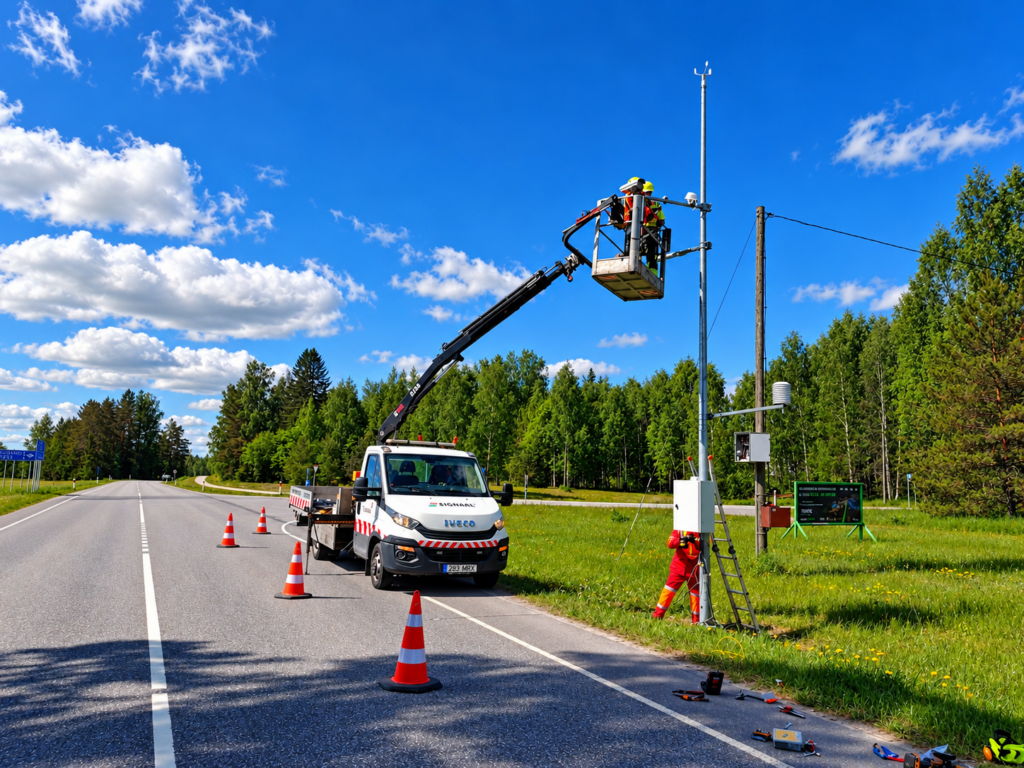
Construction usually takes place in three stages, often on separate days.
- Excavation and infrastructure installation. The mast foundation or base is installed, followed by the mast, electrical cable protection conduits, cables and supplementary earthing.
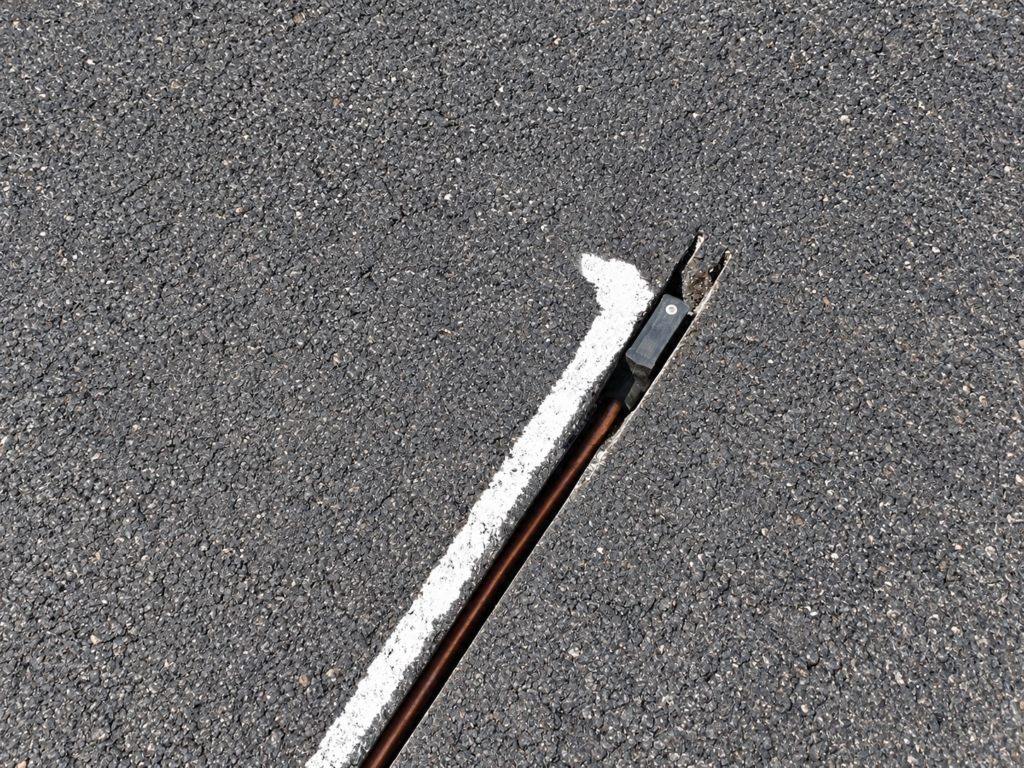
- Installation of road sensors. Sensors are installed within the road’s wearing course, meaning this work can only take place after the asphalt paving has been completed. Most stations have one road surface condition sensor. However, on dual carriageways with two lanes in each direction, sensors may be required in every lane. In such cases, installing the road sensors alone can take two days.
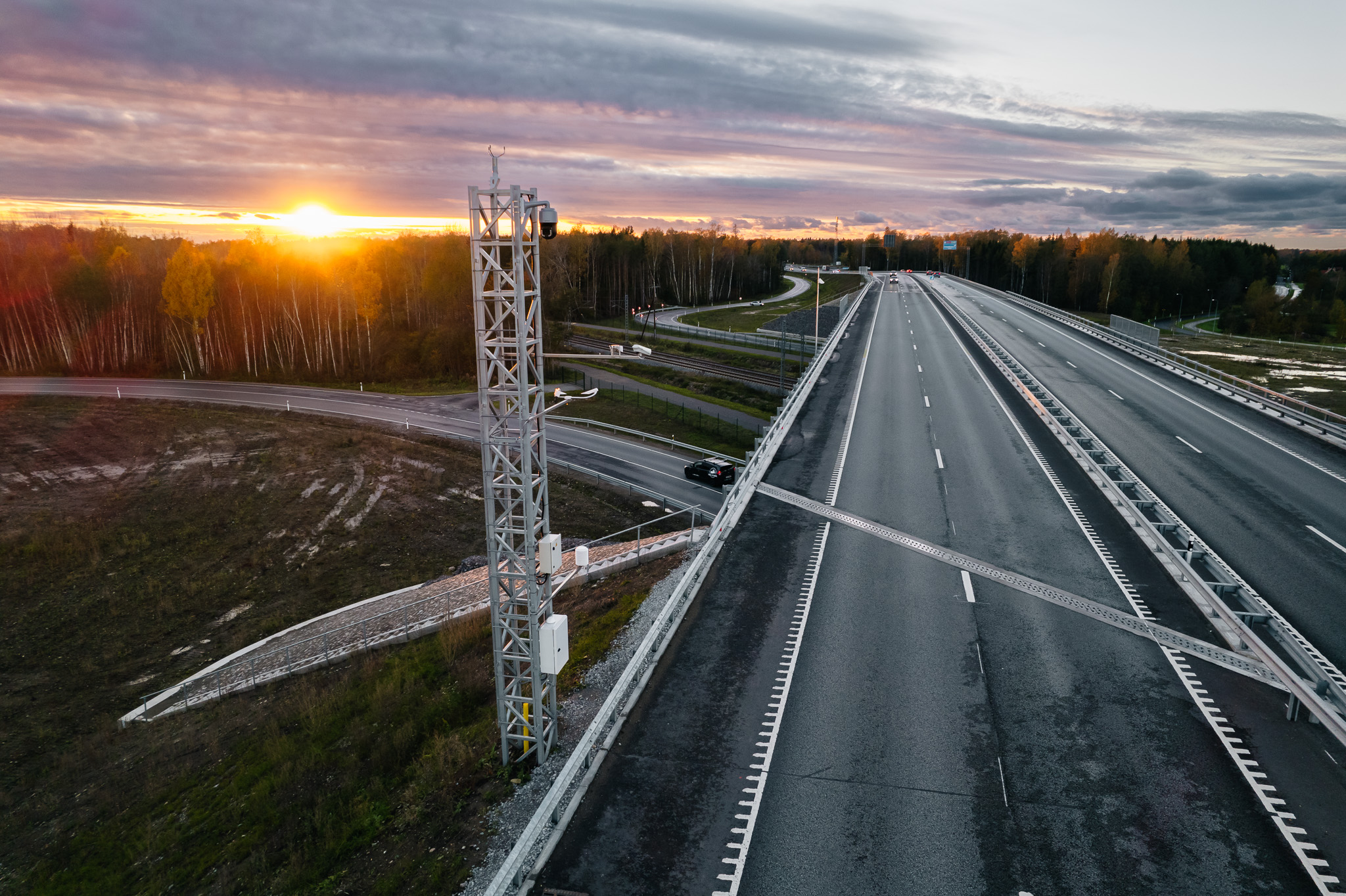
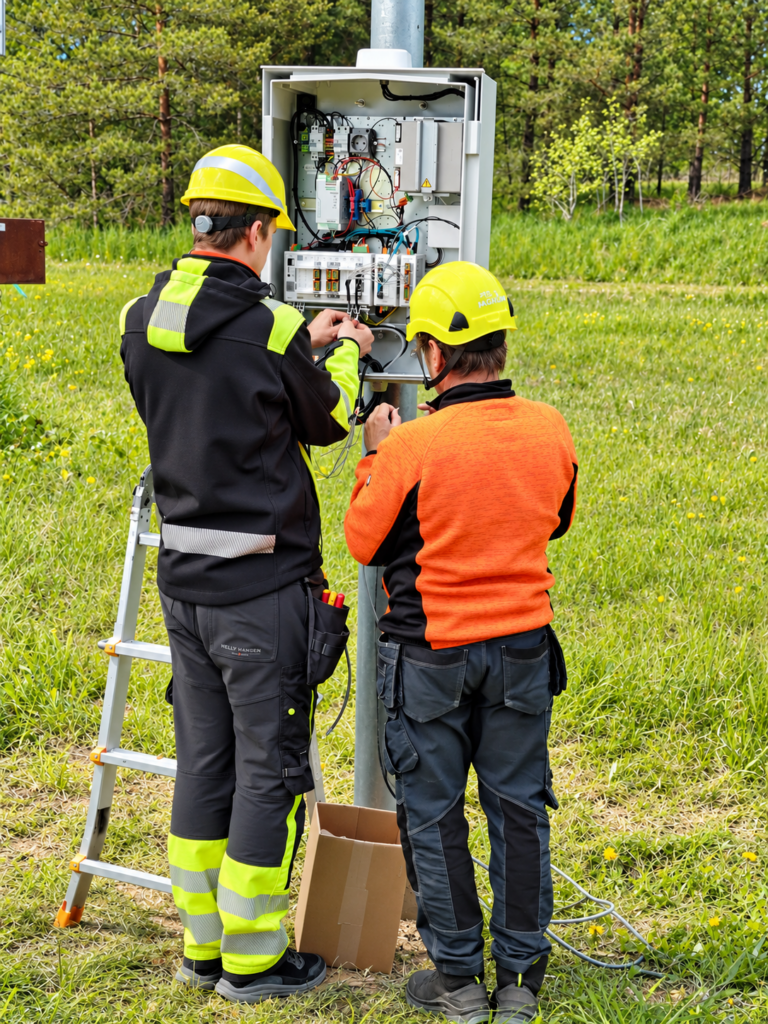
- Installation and commissioning of the station equipment. The mast-mounted enclosure containing the controller and communications equipment is installed, along with sensor booms, the traffic camera and all remaining sensors. Cables are then routed into the enclosure, and the sensors, earthing and power supply are connected. Once the system has been started and configured, the station immediately begins collecting and transmitting measurement data.
Which sensors are installed in the road surface?
Vaisala DRS511
The main and most important road sensor is the Vaisala DRS511 road surface condition sensor. It is installed horizontally in the road surface, between 0 and 3 mm below the surface, directly within the wheel track.
The DRS511 measures: Road surface temperature. Temperature beneath the road surface at a depth of 6 cm. The amount of water on the road surface. Road surface condition: dry, damp, wet, snow, ice or frost. The potential for black ice formation. Chloride concentration. The freezing point of the salt solution on the road surface.
The DRS511 is particularly valuable for winter road maintenance because it tells road maintenance managers whether the road is icy, whether it may become icy soon, and whether sufficient chloride-based anti-icing material has been applied or additional treatment is needed.
Vaisala DTS12G
A Vaisala DTS12G sensor is also installed to measure the temperature 30 cm below the road surface.
This sensor is important because it measures the thermal energy stored in the road subgrade — in other words, how much heat or cold is stored within the road structure.
At first glance, it might seem that measuring air and road surface temperatures would be sufficient to predict ice formation. In reality, the situation is more complex.
For example, on an autumn evening, the air temperature may fall to −4°C while the measured road surface temperature remains at +1°C.
It might seem that the road surface will soon drop below zero, causing moisture on the surface to freeze and create slippery conditions. However, this may not happen because the temperature of the subgrade at a depth of 30 cm is +6°C. Heat rises from the ground below, preventing the surface from cooling as quickly.
The opposite happens in spring: a frozen subgrade prevents the road surface temperature from rising as quickly as the air temperature.
Which sensors are installed on the mast?
Vaisala WMT700
Let us examine the mast-mounted sensors from top to bottom.
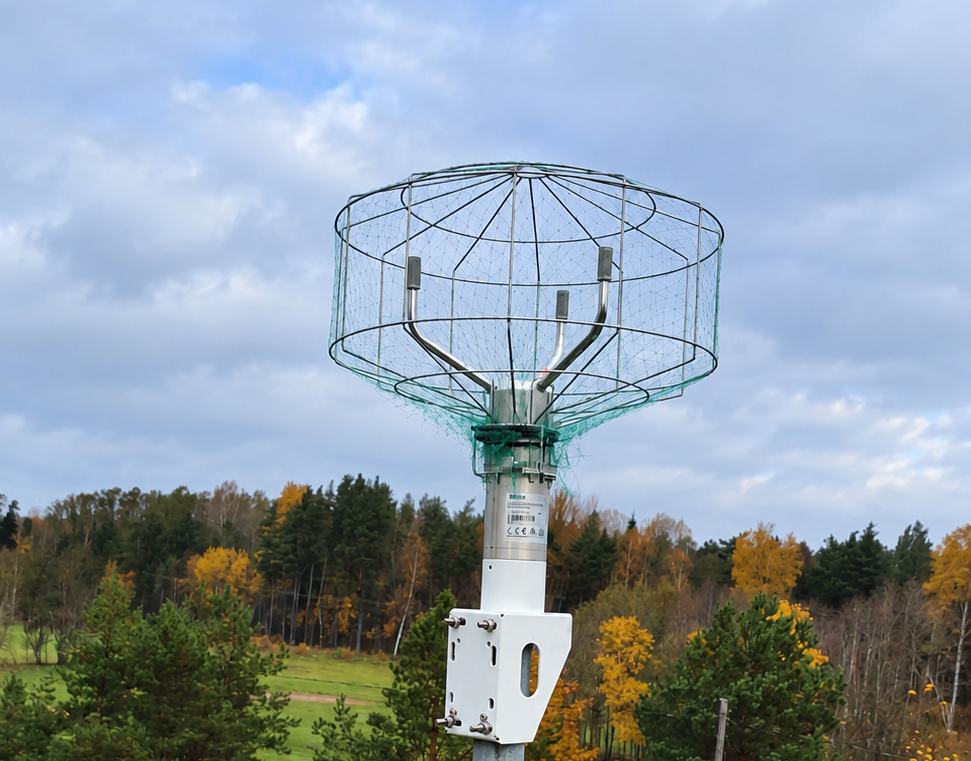
At the top of the mast, usually around 9 metres above ground level, the Vaisala WMT700 wind sensor uses ultrasonic technology to measure wind speed and direction.
Unlike wind sensors used in earlier generations of road weather stations, the WMT700 has no rotating cups or other moving parts, making it virtually maintenance-free.
The sensor contains three ultrasonic transducers positioned at the vertices of an equilateral triangle. They transmit ultrasonic signals to one another and measure precisely how long each pulse takes to travel between the transducers. In the absence of wind, sound travels at the same speed in both directions.
When wind is present, ultrasonic pulses travel faster in the downwind direction and more slowly against the wind. By comparing travel times in both directions, the WMT700 calculates the wind speed along each measurement path. Measurements taken in several directions allow the device to determine both wind speed and direction.
Wind data may initially seem unnecessary in a road weather station’s data package, but it is an important input for road weather models.
For example, strong, cold winds cool road surfaces more rapidly than calm conditions. Wind measurements therefore help improve predictions of road surface cooling and the resulting risk of ice formation. Wind data is also important for forecasting reduced visibility and snow accumulation caused by drifting snow.
Vaisala DSC211
The Estonian Transport Administration has also included a non-contact road surface condition sensor in its standard road weather station specifications.
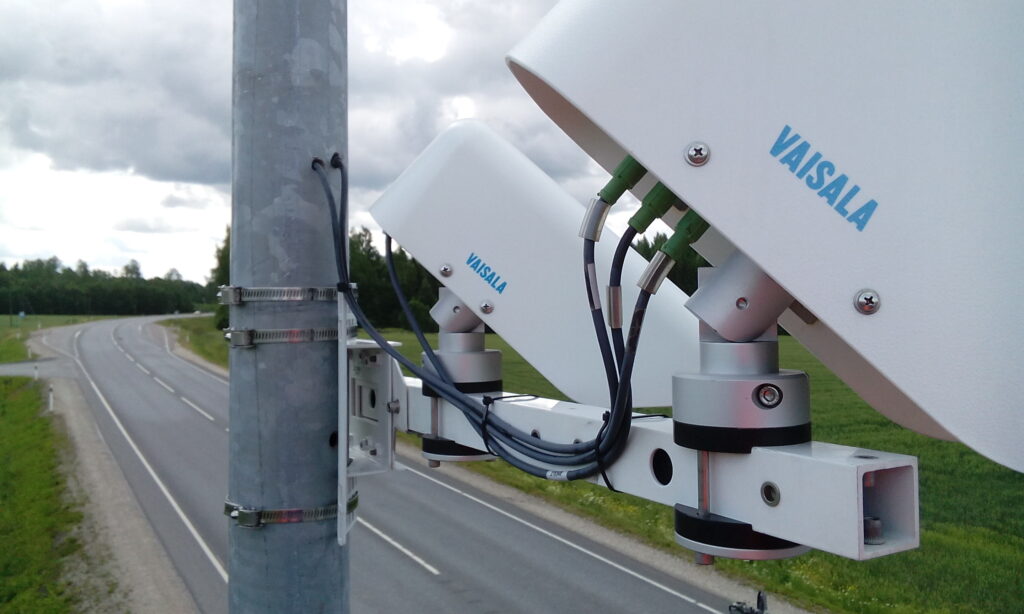
The Vaisala DSC211 is mounted on a boom attached to the mast rather than being embedded in the road surface. Using laser technology, it measures the thickness of water, ice and snow layers on the road from a distance of approximately 8–12 metres.
Based on these measurements and its internal algorithms and models, the sensor estimates road surface condition — dry, damp, wet or icy — and calculates a friction coefficient.
The main difference between the DSC211 and the embedded DRS511 sensor is that the DSC211 cannot detect chlorides applied to the road.
Nevertheless, the DSC211 plays an important role in road safety because it can detect the formation of ice crystals on the road surface before drivers notice that the road has become slippery.
This allows the Estonian Transport Administration to warn road users about slippery conditions more quickly using variable message signs on traffic-managed road sections. It also gives road maintenance contractors time to respond before dangerous conditions develop.
Vaisala PWD22
The next sensor is the Vaisala PWD22, which measures visibility and detects the presence, type and intensity of precipitation.
Installed at a height of approximately 5–6 metres, the sensor measures visibility over a range of 10–20,000 metres. It identifies different types of precipitation, including rain, snow, sleet, freezing rain and hail, and measures precipitation intensity and amount.
One of the PWD22’s most important capabilities is detecting freezing rain, which causes numerous traffic accidents every year.
When the road surface temperature is at or below zero, freezing rain droplets can form an ice layer almost instantly upon contact with the road. Conditions can become dangerously slippery so quickly that drivers may lose control of their vehicles before they realise the danger.
Precipitation measurements are also necessary for assessing the risk of aquaplaning, which can occur when heavy rainfall exceeds the road’s ability to drain water away.
Visibility is another critical road safety factor. The PWD22 helps identify reduced visibility caused by fog, heavy snowfall, blowing snow and intense rainfall.
While most road weather station measurements are particularly important during the winter maintenance season, precipitation and visibility data are relevant to road safety throughout the year.
Vaisala HMP155E
Finally, the Vaisala HMP155E measures air temperature and relative humidity.
It is one of the station’s key sensors because the combination of air temperature and humidity largely determines when frost, freezing conditions, fog and other hazardous road conditions may occur.
The HMP155E is installed approximately 3 metres above the road surface and measures air temperature and relative humidity.
Based on these measurements, the road weather station controller also calculates dew point temperature, the probability of frost formation, atmospheric moisture content and the risk of freezing.
For winter road maintenance, road surface temperature and dew point are among the most important forecasting parameters. When the road surface temperature approaches or falls below the dew point, the risk of moisture condensation, frost formation and slippery conditions increases significantly.
Without accurate air temperature and humidity measurements, it is not possible to reliably forecast frost, freezing conditions, fog and many other phenomena that are important for winter road safety.
Why does a road weather station include a traffic camera?
A traffic camera is included so that road maintenance managers can verify whether the measurements collected by the station’s sensors and the assessments generated by its internal algorithms and road weather models reflect actual conditions.
The station provides a set of measurements for road weather models, while the camera makes it possible to check whether the resulting conclusions match reality.
Images from the camera allow road maintenance managers to see whether there is actually ice on the road, whether it is snowing or sleeting, how strong the drifting snow is, whether the lanes are clear and how quickly road conditions are deteriorating.
If the sensors answer the question, “What do the measurements show?”, the traffic camera answers, “What does the situation actually look like?”
This is why road maintenance managers closely monitor camera images from their maintenance areas during the winter season, even though actual maintenance decisions are primarily based on sensor measurements and road weather forecasts.
How is traffic managed during construction?
Traffic management during road weather station construction is organised according to the nature of the work and the Estonian Transport Administration’s guidelines for temporary traffic management on national roads.
I have always emphasised to my team that the first priority on site is to ensure our own safety, followed by the installation of the required temporary traffic management equipment.
Our responsibility is to protect both road users and people working on or beside the road, while ensuring compliance with all applicable requirements.
The most dangerous and challenging task is installing the road sensors. This inevitably requires closing a traffic lane or an entire direction of travel, while ensuring the safety of everyone within the work zone using a TMA vehicle or alternative protective solutions.
Unfortunately, Estonian drivers do not always prioritise compliance with speed limits in work zones.
Configuration and Maintenance
What happens after installation?
The sensors arrive from the manufacturer already calibrated and factory-tested, so additional calibration at the installation site is generally unnecessary.
However, the system must be configured after installation. The settings depend on the specific site and the distance between the sensors and the road surface. For example, the laser focus distance of the non-contact road surface sensor must be adjusted.
The road weather station controller and communications connection are then configured, and the required parameters are entered into the Estonian Transport Administration’s data collection application.
Once configuration is complete, the station immediately begins transmitting measurement data and traffic camera images. The data is delivered to the Transport Administration’s data warehouse and then made available through the TarkTee portal.
Testing, configuration and activation of data transmission are generally completed on the same day that the installation work is finished.
How do we verify that the data is accurate?
After installing a new road weather station or reconstructing an existing one, we monitor its operation for one week.
During this period, we compare its measurements with data from nearby stations and assess whether the measurement graphs are logically consistent with one another. If no anomalies are detected during the monitoring period, the installation and configuration are considered successfully completed.
Where necessary, we can make further adjustments to the precipitation and visibility sensor, road surface sensor, and air temperature and humidity sensor on site. Other sensors can only be calibrated at the manufacturer’s factory.
How many road weather stations are there in Estonia, and how are they maintained?
The Estonian Transport Administration’s road weather station and traffic camera network currently comprises 122 road weather stations and 180 traffic cameras.
In recent years, the entire network has been upgraded, and the latest-generation Vaisala RWS200 road weather stations are now in use.
The maintenance partner for the road weather stations and traffic cameras is selected through a public procurement procedure. We have been a trusted partner of the Estonian Transport Administration in the construction and maintenance of road weather stations since 2013, and we currently hold the maintenance contract.
Maintenance includes continuously monitoring station reliability, sensor condition and data transmission. The time allowed to resolve faults depends on their impact on the availability of road weather data and road safety.
Under the current maintenance contract, the most critical faults must be resolved within 24 hours.
The contract also requires all road weather stations to undergo scheduled annual maintenance before the start of the winter road maintenance season.
During this maintenance, sensors and traffic cameras are cleaned, measurement accuracy is checked, embedded road sensors are serviced, and equipment is calibrated where necessary in accordance with the manufacturer’s requirements.
Why do road weather stations require maintenance?
Reliable and accurate road weather forecasts are essential for timely and effective winter road maintenance.
Road weather forecasting combines predictions from different road weather models, weather radar and satellite imagery, and measurements collected by road weather stations. This information is used to generate forecasts for a specified area, such as the whole of Estonia.
Weather conditions are constantly changing. High-quality road maintenance management software accounts for these changes by incorporating new measurements from road weather stations at five-minute intervals and adjusting model forecasts accordingly.
This highlights the most important reason for maintaining road weather stations: properly maintained stations provide reliable and accurate measurements, while poorly maintained stations may produce unreliable or incorrect data.
In simple terms, well-maintained road weather stations improve forecast accuracy, whereas poorly maintained stations make road weather forecasts less accurate.
Conclusion
Road weather stations and road weather forecasts may not seem like the most visible or “glamorous” part of the transport system at first glance. In reality, road weather stations, together with road weather models and modern road maintenance management systems, form one of the most important sets of tools for ensuring safe, well-maintained roads in winter.
You could even say that the greatest compliment to road weather stations and road maintenance teams is when nobody notices them. When road users reach their destinations without having to worry about road conditions, it means that timely decisions have been made based on accurate road weather forecasts and that maintenance operations have been proactive and effective.
It is encouraging to see that the Estonian Transport Administration has consistently developed and modernised its road weather station network in recent years. Thanks to these investments, Estonia’s national roads are now served by the most up-to-date road weather station network in its history, providing a strong foundation for the upcoming winter road maintenance season.
As of today, the average age of the Estonian Transport Administration’s road weather stations is just 4.2 years, while the typical service life of a road weather station is approximately 15 years. This means that most of the network is technologically modern and capable of providing high-quality measurement data for many years to come.
If this gives the impression that taxpayers’ hard-earned money has been spent for nothing, the reality is quite the opposite: road weather stations are among the most cost-effective investments in the road infrastructure sector.
As mentioned earlier, estimates suggest that every euro invested in establishing, upgrading or maintaining a road weather station network can generate five to ten euros in benefits for society. These benefits include lower road maintenance costs, more efficient winter maintenance operations, fewer traffic accidents, smoother traffic flow and, ultimately, lives saved.
I also have a small request for all road users: please stay alert and pay close attention to temporary traffic management measures. Watch out for vehicles operating with flashing amber lights and road workers wearing high-visibility orange clothing. Slow down as you approach a work zone.
We all want our loved ones to make it home safely at the end of the day.
Thank you!
Need a road weather station installed, sensors replaced, or maintenance carried out?
We build, configure and maintain traffic cameras and road weather stations throughout Estonia. We are a trusted procurement, installation and maintenance partner to the Estonian Transport Administration for road weather stations and traffic cameras.